21 Famous food advertisements (and what made them iconic)
TABLE OF CONTENTS

TL;DR
- ✅ The most-cited benchmarks in food advertising: KFC "Oh FCK!", Burger King's Moldy Whopper, Chipotle "Back to Start," and Coca-Cola's "Share a Coke"
- ✅ The common thread: the best food advertisements use humor, honesty, or emotional storytelling, rarely all three, but always one executed with conviction
- ✅ Fast food brands dominate this list because their budgets are large and their rivalries are real: McDonald's and Burger King alone account for six entries
- ❌ Big budgets don't explain it: KFC's "Oh FCK!" crisis ad was essentially a single print placement, cost almost nothing, and generated international press coverage
Introduction
Food advertisements are promotional materials created by food and beverage brands, across print, television, digital, and outdoor media, designed to trigger desire and drive purchase decisions. At their best, they don't just sell a product. They become part of the culture.
The numbers show how much the industry invests in this. Food, beverage, and restaurant companies in the United States spend close to $14 billion annually on advertising (University of Connecticut Rudd Center). A single well-executed campaign can move the needle dramatically: McDonald's BTS Meal promotion, a social-first campaign built around viral packaging, drove a 25% increase in US same-store sales in the quarter it ran.
Good food advertising is also a design problem. Research from MDG Solutions found that 67% of consumers consider product image quality "very important" to their purchase decision, ranking it above product descriptions, reviews, and pricing detail. The visual is doing the heavy lifting before a single word is read.
Since food is first tasted through the eyes, learning from the best food advertisements in history is one of the most direct routes to understanding what great food advertising looks like. Print ads are still around and particularly effective when a juicy meal on a billboard catches you mid-commute. And a mouth-watering TV ad can prompt a fridge raid before the spot has even finished.
That's exactly what a good, well-thought-out ad can do: create a sense of urgency and awaken hunger for something specific. Food marketing is often centered on hunger, one of the most basic and powerful human drivers in advertising.
But as the 21 campaigns below show, hunger is not the only creative route. Here's your food for thought.
What makes a food advertisement iconic?
Most food ads get forgotten within a week of running. The ones on this list are still being referenced, studied, and copied years later. They all do at least one of three things well.
They appeal to something primal. Food is tied to hunger, comfort, memory, and pleasure. The best food advertisers treat that as an advantage rather than a starting point. A McDonald's ad isn't just selling fries. It's selling the specific satisfaction of eating fries at 2am after a long night out. The emotional payload is what makes it memorable.
They have a clear, surprising idea. KFC rearranging their bucket letters to say "FCK" after running out of chicken was surprising. Burger King publishing a time-lapse of a rotting Whopper was surprising. Each idea is describable in one sentence, which is the clearest test of whether an idea is strong enough to build a campaign around.
They are honest about what they are. The Domino's "Pizza Turnaround" campaign worked because the brand admitted, on camera, that their pizza was not good enough. That kind of transparency is rare in advertising and builds credibility that no polished campaign can replicate.
The 21 food advertisement examples below demonstrate all three patterns across decades and formats, from a single print ad to a decade-long campaign built on talking cows.
{{PRINT_PORTFOLIO="/dev/components"}}
21 Famous food advertisement examples
1. Pizza Hut: bringing the taste (and look) of Italy
Pizza Hut's print campaign leaned on one of the most recognizable symbols in the world, the Leaning Tower of Pisa, and gave it a pizza twist. The result was a clever, instantly readable visual: if you can't get to Pisa, you can at least see the leaning tower of Pizza.
Pizza is the most popular Italian export, and this ad worked precisely because it borrowed the cultural authority of Italy to elevate the product. The visual does the entire job. There's no body copy needed when the image communicates the joke in under a second.

2. Burger King: Sticking to tradition
The clearest differentiator between Burger King and most fast food chains is that their burger patties are flame-cooked. Burger King took pride in that method, so they built a whole print campaign around a simple idea: if something isn't broken, don't fix it.
These print ads are quirky and confident, and they communicate the brand's positioning without a single diagram or product comparison. The strategy is worth noting for any food brand: commit to the thing you do differently, and say it with conviction.

3. McDonald’s: Food for the night owls
If your restaurant delivers during the night, that's a value worth advertising directly. This McDonald's print campaign did exactly that, transforming nocturnal animals (owls, raccoons, bats) into recognizable fast food items to make the point that McDonald's is open for business when most places aren't.
The visual execution is striking and the message lands instantly. It's a good example of a food advertisement that identifies a specific audience (people awake and hungry late at night) and speaks directly to them, rather than trying to appeal to everyone at once.

4. Snickers: You're not you when you're hungry
One of the most awarded food advertising campaigns of the 21st century. Launched during the 2010 Super Bowl with an ad starring Betty White being tackled in a football game, "You're Not You When You're Hungry" ran in over 50 countries and won an Emmy for Outstanding Commercial. The premise is simple: hunger makes you someone else. A Snickers fixes that.
What made the campaign remarkable was its versatility. The same core idea worked with dozens of celebrity replacements, across cultures, over more than a decade. The Snickers bar itself was almost incidental: the concept was the product. That's the level of strategic clarity that separates a campaign from a one-off ad.
5. Maggi: Feels like home
A bowl of warm soup carries a specific emotional weight that Maggi understood well enough to build a campaign around it. This ad communicates that even in the worst of circumstances, the feeling of home is achievable. It's a direct appeal to comfort and memory, two of the most reliable levers in food advertising.
Maggi is a Nestlé brand with a presence across Asia, Africa, and Europe, and the campaign resonated globally precisely because the emotion it targeted is universal. You don't need to explain what "home" feels like. You just need to associate your product with it convincingly.

6. Domino's: Pizza turnaround
In 2010, Domino's faced a very public reckoning. Customers and food critics were openly saying the pizza was bad. Most brands would have quietly retooled and moved on. Domino's did the opposite: they made a documentary-style campaign called "Pizza Turnaround" showing the actual customer complaints, the team's visible embarrassment, the recipe overhaul, and CEO Patrick Doyle personally owning the problem.
The honesty was the strategy. The campaign generated enormous press coverage and positioned the brand as trustworthy at a moment when trust was the only thing that mattered. Domino's stock, which was trading around $8 per share in early 2010, climbed steadily in the years that followed as the brand rebuilt its reputation. It's one of the clearest examples in food advertising of transparency outperforming spin.
7. Oreo: Whisper fight
Oreo's 2013 Super Bowl spot put two groups of people in a library in a tense, hushed argument about whether the cream or the cookie is the best part of an Oreo. The concept is absurd, the execution is precise, and the ad lands in under 30 seconds.
What makes it a model for food advertisers is the subject of the argument itself. Oreo didn't invent the cream-versus-cookie debate: it had existed among fans for decades. They simply turned a genuine piece of audience behavior into a campaign. That's a different creative instinct to manufacturing a premise, and it's why the ad felt so immediate.
8. Wendy's: "Where's the beef?"
Launched in 1984, Wendy's "Where's the Beef?" campaign featured actress Clara Peller peering inside a competitor's bun and demanding to know where the meat was. The phrase entered mainstream culture almost immediately, appearing in political debates, late-night monologues, and everyday conversation across the US. [VERIFY: campaign reportedly contributed to a 31% revenue increase for Wendy's in the year following launch].
The ad worked because it attacked a real frustration (small burger patties hidden under large buns) in a way that was funny rather than aggressive. It positioned Wendy's as the honest alternative without ever mentioning a competitor by name. Forty years later, "Where's the beef?" is still understood as a challenge to substance over style.
9. McDonald’s: Count to three, and they’re gone!
The simple visual of a potato moving from field to fork to fryer to mouth, and then disappearing before you've finished counting, and it's one of the most efficient fast food ads in history. It focuses on a single product that almost everyone loves and doesn't oversell it.
The restraint is what makes it work. McDonald's fries are already desirable. The ad's job is only to remind you of that desire and associate it with McDonald's, not to explain, justify, or elaborate. More food advertising should apply this logic.

10. KFC: Finger lickin' goodness
KFC's slogan "Finger Lickin' Good" is one of the most recognized taglines in fast food history, and the print campaign that visualized it remains among the best food ad designs ever produced. A greasy thumb and palm print in the shape of a chicken drumstick communicates everything: the product, the texture, the experience, without a single word.
Then came 2020. At the height of the pandemic, KFC made the extraordinary decision to pause the 64-year-old slogan because public health guidance made "licking your fingers" a complicated message. Rather than quietly shelving it, they released a campaign that blurred out the slogan in every frame. It generated more press than almost any KFC ad in years. The brand turned a constraint into a campaign, which is exactly the instinct that separates good advertising from great advertising.

11. Burger King: The glove is thrown
The rivalry between McDonald's and Burger King is one of the most entertaining ongoing campaigns in advertising history. Burger King's core attack has always been the size of the Whopper, and this ad made that point as directly as possible: they tried to fit a Whopper into a Big Mac box and simply couldn't. It didn't fit.
No clever copy is needed. The image says everything. This is a useful reminder that the strongest comparative food advertisements don't argue: they demonstrate.

12. McDonald’s: For experts only
To promote a new layered sandwich, McDonald's Germany stacked books and encyclopedias about each ingredient, one on top of the other, to mimic the architecture of the product itself. The stack became the ad. The headline wrote itself.
It's a clever piece of ad design that does something difficult well: it communicates complexity (many ingredients, expertly assembled) in a way that reads as playful rather than intimidating.

13. KFC: Oh FCK!
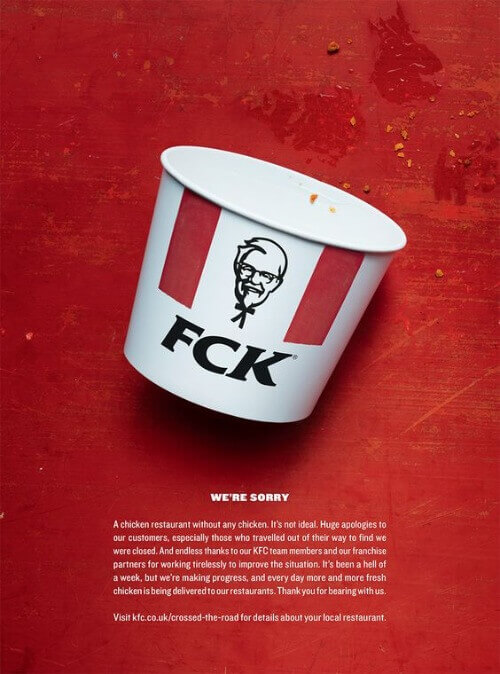
In early 2018, the UK branch of KFC ran out of chicken. Restaurants closed. Customers were furious. The internet piled on. KFC's response was a single full-page newspaper ad: an empty KFC bucket with the letters rearranged to read "FCK," below which was a simple, direct apology that took full responsibility without deflecting, explaining, or making excuses.
It became one of the most shared pieces of brand communication that year. The ad won multiple industry awards, but more importantly it turned a genuine crisis into a demonstration of character. It's one of the best arguments that exists for honesty as a creative strategy in food advertising. When things go wrong, the brand that owns it loudest usually comes out ahead.
14. McDonald’s: One for the vegetarians
To launch their veggie burger in Germany, McDonald's assembled a collection of vegetables in the shape of a cow, the very animal a traditional burger comes from. It's a clever visual that acknowledges the tension directly and makes the point with humor rather than defensiveness.
For brands launching products aimed at a specific dietary preference, this is a useful template: speak to the audience's actual values (in this case, not eating beef) rather than trying to reassure them that your product is "just like the original."

15. Burger King: Could it get scarier?
For Halloween, Burger King dressed as McDonald's. The campaign showed Burger King restaurants covered in white sheets, the classic ghost costume, with a "Booo!" headline and a simple message: this is the scariest thing we could think of.
It's a masterclass in brand confidence. The joke only works if your audience believes you'd rather be caught dead than be your competitor, and Burger King had spent enough years building that reputation for the gag to land. Not every brand can pull this off. Burger King can.

16. Burger King: Brave and honest
To prove their burgers contain no artificial preservatives, Burger King published a time-lapse of a Whopper decomposing over 34 days. It's genuinely unpleasant to look at. That's the point. The tagline: "The beauty of no artificial preservatives."
The ad made an implicit contrast with McDonald's, whose Big Mac famously remained mold-free for over 10 years in an Icelandic museum. Burger King didn't need to name their competitor. Every viewer understood the reference. The Moldy Whopper campaign won the Grand Prix at Cannes Lions and demonstrated that a food brand willing to show something ugly in the name of honesty will be trusted more, not less.!

17. Chipotle: Back to Start
A two-minute animated short film scored to Willie Nelson's cover of Coldplay's "The Scientist," Chipotle's "Back to Start" follows a farmer's journey from small-scale sustainable agriculture, to industrialized production, and back again. It's a motion graphics campaign that tells a complete story with no dialogue.
The ad was striking because it didn't sell a menu item or a price point. It sold a set of values (sustainable farming, responsible sourcing) and trusted viewers to make the connection to Chipotle's food themselves. If your brand doesn't have the production budget for this kind of execution, motion graphics agencies can achieve a similar effect at a fraction of the cost.
18. Taco Bell: Viva Young
Many successful video food advertisements mirror everyday situations viewers recognize. Taco Bell took the opposite approach: their 2013 Super Bowl ad "Viva Young" showed a group of elderly nursing home residents sneaking out for a wild night out, scored to a Spanish-language cover of "We Are Young" by fun. The night ends, naturally, at Taco Bell.
The ad works because it subverts expectations completely. The joke is absurdist, the casting is inspired, and the late-night Taco Bell moment lands as the perfectly logical conclusion to an unlikely evening. It's a reminder that memorable food advertising often comes from asking what the audience least expects and then committing to that fully.
19. Coca Cola: Share a Coke
The premise behind "Share a Coke" is almost embarrassingly simple: replace the Coca-Cola logo on the bottle with a popular first name and let people find their own. The campaign launched in Australia in 2011 and rolled out globally in subsequent years, running in over 80 countries.
The results were not embarrassingly simple. The campaign helped Coca-Cola increase revenue by over 11% in key markets, reversing years of declining sales. The social media impact was enormous: people shared photos of their named bottles in huge numbers, creating earned media that extended the campaign far beyond its paid placements. It's one of the clearest examples in food advertising of personalization as a strategy rather than a tactic.

You wouldn’t think something as simple as this would be so impactful, but the results definitely speak otherwise. Share a Coke campaign helped the Coca-Cola company to increase their revenue by over 11%. And when a brand is as popular and long-lasting as Coca-Cola, this number is pretty major!Not only that, the social impact of the campaign (the social media shares, etc.) was also immense, helping increase brand visibility and make it top of mind for its consumers.
20. Chick-Fil-A: Eat Mor Chickin
A campaign that ran for over 25 years and featured cows encouraging people to eat more chicken rather than beef. The spelling is intentionally wrong. The cows are mildly threatening. The logic is self-serving in a way the audience is supposed to notice. The campaign is darker than it appears on the surface, and that tension is part of what makes it memorable.
What the Chick-Fil-A campaign proves is that longevity requires a strong enough idea to sustain repetition. Most campaigns exhaust themselves inside two years. "Eat Mor Chickin" ran for a quarter century because the core conceit (cows with a vested interest in chicken sales) never stopped being inherently funny.

21. Doritos: Crash the Superbowl
Doritos' "Crash the Super Bowl" was a user-generated content campaign that ran from 2006 to 2016, inviting fans to create their own commercials for a chance to have them aired during the Super Bowl. The prize was $1 million and national airtime. The campaign received over 32,000 submissions and produced several top-ranked Super Bowl ads, including "Sling Baby" and "Free Doritos," which regularly outperformed big-budget productions in post-game audience rankings.
By handing creative control to its audience, Doritos built brand engagement, generated massive earned media, and kept production costs low while achieving Super Bowl-level visibility. It's one of the most studied examples of user-generated content as a marketing strategy, and it worked because the brand trusted its own fans to understand what made Doritos funny.
Frequently asked questions about food advertisements
Bottom line
These 21 food advertisements are some of the best examples of visual storytelling and effective marketing strategy in advertising history. Looking across all of them, a few patterns emerge consistently.
The best food ads commit to a single idea. "You're not you when you're hungry." "Where's the beef?" "FCK." Every one of these campaigns is reducible to a sentence, which is the simplest test of whether a creative idea is strong enough to build around.
They're also honest, often uncomfortably so. Domino's admitting their pizza was bad. Burger King publishing a rotting Whopper. KFC printing "FCK" in a national newspaper. Food advertising at its best treats the audience as intelligent adults who can handle the truth, and rewards them for paying attention.
Finally, the format barely matters. Brilliant food advertising has been done as a print ad, a 30-second Super Bowl spot, a two-minute animated film, a single tweet during a blackout, and a user-generated content contest. What matters is the idea.
If you need help with the design side of your food advertising, whether that's social media ads, food packaging design, or a full ad campaign, ManyPixels gives you access to a professional design team at a flat monthly rate. Unlimited requests, unlimited revisions, and your first draft back within 24 to 48 hours.
Sign up today and start creating mesmerizing ads for your food brand. Or get in touch with us to learn more.

Journalist turned content writer. Based in North Macedonia, aiming to be a digital nomad. Always loved to write, and found my perfect job writing about graphic design, art and creativity. A self-proclaimed film connoisseur, cook and nerd in disguise.

Top-quality designers
A complete creative team at your fingertips: graphic and web designers, illustrators, and more.

Lightning-fast turnaround
Get start today and receive your first update on the next business day.

All-inclusive pricing
Unlimited requests and revisions. One flat monthly fee. No surprises.

Flexible & scalable model
No contract. Scale up and down as needed. Pause or cancel at anytime.
Continue reading


Explore some of our best designs
Get inspired by a curated selection of ManyPixels work. Download the portfolio to see what our team can create.